
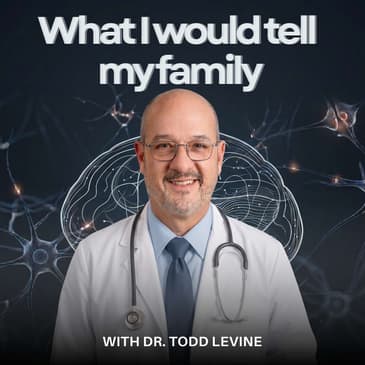
Have you ever left a neurologist’s office with more questions than answers? Or struggled with a diagnosis that felt like the end of the road instead of a new beginning? On this premiere episode of What I’d Tell My Family, host and renowned neurologist Dr. Todd Levine to uncover the philosophy that drives his uniquely patient-centered approach to care. Drawing on decades of experience and his own journey as a patient—Dr. Todd Levine explains why every recommendation he gives starts with two fundamental questions: what does the science say, and what would I do if this were my own family? Together, they explore the challenges in today’s medical system, the importance of meaningful conversation and connection, and practical ways both patients and doctors can work as a team—especially when facing difficult neurologic diseases like ALS, Parkinson’s, and Alzheimer’s. Whether you’re seeking hope, better answers, or a more personal approach to brain health, this episode sets the stage for an enlightening look at what compassionate, individualized neurology truly means.
00:00 Personal health journey insights
04:20 Honoring patient's final wishes
09:14 Early detection in concierge medicine
13:33 Comprehensive patient health evaluation
17:49 Importance of gradual physical activity
18:56 Improving Health Through Exercise and Nutrition
24:39 Experiences as patient and caregiver
25:27 Simplifying complex neurologic diseases
29:31 Improving patient outcomes in neurology
What I’d Tell My Family: Rethinking Neurology with Dr. Todd Levine
When it comes to neurology, most people are used to leaving the specialist’s office with more questions than answers. For patients — and their families — facing devastating diagnoses like dementia, Parkinson’s, or ALS, there’s often a sense of finality and helplessness. But in the very first episode of What I’d Tell My Family, Dr. Todd Levine, neurologist and founder of Neuro Concierge, explores how a radically human-centric approach can shift hope and outcomes in even the most daunting neurological conditions.
Asking the Most Important Question
Right from the outset, Dr. Todd Levine makes it clear: his practice centers around a deceptively simple guiding question — “What would I recommend if this patient were my own family?” This isn’t just a tagline; it shapes every conversation, every recommendation, and every treatment plan he delivers. Over his 30 years in neurology, Dr. Todd Levine has witnessed medicine shift from personalized consultations to an efficiency-driven, system-heavy approach, often leaving patients feeling like cases, not individuals (00:00:54).
His own journey as a patient with chronic health challenges further deepened his empathy and highlighted what’s missing in today’s healthcare: real, thorough communication, and true partnership in care decisions. For Dr. Todd Levine, knowing the science is only half the job; the other half is knowing — and caring about — what matters most to each person before him (00:02:05).
Beyond the Diagnosis: Finding What Matters
One of the episode’s most touching stories involves a woman with ALS whose final wish was to attend her daughter’s wedding, hundreds of miles away. Rather than stopping at the bleakness of an incurable diagnosis, Dr. Todd Levine and her family worked together for a solution — ultimately allowing her one last, priceless memory (00:04:28). It’s these human moments, he argues, that should drive medical care: “What do you want? How do we make that work?” (00:05:21).
This philosophy stands in stark contrast to a common neurology experience: patients told, “Here’s your diagnosis — see you in six months.” Instead, Dr. Todd Levine insists there’s always something that can improve quality of life, even if a condition remains technically incurable (00:28:51).
Concierge Care: More Connection, More Prevention
What does “concierge neurology” mean in practice? First, it means unparalleled access: patients can reach their doctor when they need them, not after months of waiting (00:07:00). Second, it involves deeply proactive care. Many neurological diseases, like Parkinson’s, can be brewing in the brain years before symptoms appear — by tapping into advanced screening and early detection, Dr. Todd Levine shifts the focus to prevention and slower progression (00:09:48).
A first “neuroche” visit, he explains, goes far beyond symptom triage. Patients get extended time with the doctor, a holistic health review (including sleep, activity, mental health, and nutrition), and state-of-the-art diagnostics (00:11:09). Follow-up is about tracking change, finding motivation, and keeping hope alive even as conditions evolve (00:14:44).
The Four Pillars: A Foundation for Brain Health
Surprisingly, the basics aren’t what most expect: the four pillars Dr. Todd Levine emphasizes are sleep, diet, movement, and social support (00:17:01). These may sound familiar yet are often undervalued in neurology. He shares that exercise, even in small increments, can spark improvement for almost any neurological disease, and that social isolation (especially among those living with chronic disease) dramatically undermines well-being (00:22:24).
Nutrition and quality sleep can slow disease progression or help prevent issues in the first place. Each pillar is so vital, Dr. Todd Levine has built a team into his practice, so patients get expert guidance on every front.
Always Hope: Neurology Isn’t Hopeless
Dr. Todd Levine believes we’re living in an era of real hope for neurology: treatments for slowing diseases like Alzheimer’s are finally emerging, and earlier intervention is more possible than ever (00:27:08). No matter where someone is in their journey, something can be done to make life better.
If there’s one message from this powerful debut episode, it’s this: diagnoses are not destinies. Neurology is evolving. And with the right partnership and perspective, there is always a way forward.
For anyone seeking clarity, empowerment, or hope in the face of a neurological diagnosis, this podcast — and this philosophy — promises a new kind of neurological care.
[00:00:00] The most frustrating new consult for me to see is a patient that comes in and says, I saw Dr. X. They diagnosed me with this disease and they said, I'll see you in six months. The approach to the patient is wrong, especially in neurology. Once many physicians label the person with that, they're like, well, there's nothing really I can do. My hope through the podcast and through Neuroconcierge is, again, really to educate people that we can always make you better.
[00:00:28] We can always improve your level of function. We can always improve your pain. We could always improve what you do on a day-to-day basis. Active approach to a patient more than the kind of hands-off approach to a disease that I think is so critical.
[00:01:05] You've left a neurologist's office with more questions than answers. You've sat with a diagnosis that felt like a door closing instead of one opening. What if there was a doctor who answered every question the way he'd want to answer his for his own family? Welcome to What I Tell My Family, Dr. Todd Levine. And in today's very first episode, we sit down with Dr. Levine to hear how he got here, how he thinks, and why he built a practice around a single question he asks before every recommendation he makes. So let's get into it.
[00:01:32] I'm excited to be here with you, Dr. Levine, and really get to know your method for, or your reasoning for this thought process and your practice. So are you excited to get started and for your first episode? Yeah, excited to talk about my philosophy to everyone. Awesome. So let's kind of start at the beginning. Can you take us back to the beginning, Duke, St. Louis, 30 years of neurology. So what was the moment you realized that the system wasn't really giving patients what they needed? Yeah, you know, unfortunately, I sound like an old guy and I'm not trying to.
[00:02:01] But medicine has changed a lot in the 30 years that I've been practicing. And so when I first came out of training, out of my fellowship from Washington University in St. Louis, I really felt like I wanted to give individualized care to patients. And I would see patients in my office and talk with them. And it was much more of a consultation than it was a doctor just spouting out facts.
[00:02:27] And unfortunately, I think medicine has evolved where most neurologists are now part of hospital systems. And hospital systems have different motivations than necessarily that one-on-one interaction. I think the other big piece for me personally is that really for the last 20 to 25 years, I've also dealt with my own chronic health issues. And so I've seen what it's like on the other side of that table or exam room.
[00:02:57] And I really began to feel over the last few years that I wanted to give my patients more conversation about what's going on with their bodies, more understanding about what's going on with their bodies. And I think from that, they can then make better choices. Because unfortunately, in neurology, we're not surgeons. So it's not you have a broken bone, we're going to fix that bone. There's not really much discussion there, right?
[00:03:23] In neurology, the diseases that we face, like dementia and Parkinson's and Lou Gehrig's and neuropathy, and these often don't have the specific pill to say we can just fix you. And so it is a matter of kind of educating and then working as a team between the doctor, myself, and the patient. Well, I am sorry to hear about your chronic health issues, but I'm sure that you being the patient on the other side definitely gave you such valuable perspective
[00:03:53] that really helped you with your practice. And I know that you have described your core framework as two core philosophies really blended into one. So what the science says and what you'd actually do if the patient were your own family. So when did you really start thinking about your practice in that way specifically? You know, for the last 30 years, one of my areas of specialty has been focusing on Lou Gehrig's disease. And that's a terrible neurologic disorder.
[00:04:20] People get progressively weaker and everyone passes away. And really, from caring for thousands of those patients in my career, I think that's what's kind of shaped the way I think about things. And so I can sit there and say to a patient, yes, unfortunately, you have this terrible disease. And right now we don't have any way to treat that. That could be the end of the discussion. And for a lot of physicians, when they talk to patients,
[00:04:47] leave with that concept as that is the end of the discussion. I'm going to die. There's nothing that we can do. I've really begun to see this as, you know, an opportunity to understand what's important to that patient. And as an example, I tell of a woman that I was treating with ALS nearing the end of her life. And the one thing she wanted was to be able to see her daughter get married. And she was in Arizona with me. The wedding was going to be in Minnesota.
[00:05:16] And in order for her to do that, we had to put her on a breathing machine. And her husband drove her across the country so she could be at the wedding. And then eventually, you know, shortly after, she passed away. On the one hand, that's awful and terrible. But on the other hand, for the daughter who got married, for the family and for the patient who passed away, that was a really meaningful thing. And so what I tend to say to people, whether it's with terrible diseases like that or hopefully less terrible diseases,
[00:05:45] what's important to you? What do you want? Right. And then how do we make that work? And I think that's really important because, again, in neurology, the science has not advanced to where we want it to be. I want to have treatments that fix Alzheimer's and these diseases, but we don't. And so it's really a matter of trying to understand the patient, understand the family, and to deliver what we can.
[00:06:09] And so that philosophy that I talk about very much when I think about having that conversation with the patient, which can be very difficult to say, we don't have the fix, right? I wish I was the surgeon that could fix this, but I can't. But then I say, again, if you were my family member, if you were my brother, my sister, what conversation would I have with you? And the conversation I'd have with you is, yes, we're going to do everything we can on the science side of things.
[00:06:36] But now let's talk about what's meaningful to you and what we need to accomplish for that and work as that team to try to make that happen. That's a really, really touching scenario. And I'm sure you deal with a lot of patients and scenarios like that. But I think being able to really have that discussion with the patient and the family, like you said, really figure out what it means most to them is super valuable and really gives people at the end of their life great memory. And it's super important.
[00:07:05] And I know that you founded neuroconcierge. So what does concierge actually mean in neurology and why does it matter so much? Yeah, so I think there's really kind of two approaches to concierge medicine in neurology. The first is sort of the ability to have access to your doctor.
[00:07:23] And so many of the conditions that we treat really require fairly frequent changes in medication regimens or approaches to how we manage that patient. And unfortunately, you know, the average wait time to get into a neurologist could be three to six months, depending on where you are. And for me to see a patient and to say, OK, I want to make this medication change, come back in six months and we'll evaluate if that worked.
[00:07:52] That's not really the best way to take care of people. Very often we need it to be managed weekly to say, for example, if we're changing medications that can help a person's blood pressure, we want to make that change, evaluate in a week, make another change, evaluate in a week. And the health care system just isn't really set up for that kind of frequent touch points.
[00:08:14] And so that's to me, that's the sort of the first concept of this concierge approach is I want to be able to have the time to devote to my patients whenever that's needed. So the middle of the night, weekends, whatever, they're not doing well, they can reach me. So that's, I think, kind of the first. The second is a little more sort of out of the box thinking, but it's really the evolution of what we call preventative neurology.
[00:08:38] And so we now know, for example, that there are many things that we can do to slow down the course of many diseases. So if you're beginning to have issues with your memory, there are many things that we can do to slow down the progression of that memory loss. If you're developing Parkinson's disease, again, many things that we can do to slow the progression of these terrible diseases, even if we can't reverse them.
[00:09:06] My research over the past 10 or 15 years has really been dedicated to earlier and earlier detection of these diseases. And the reason I think this is so important is if you think about, for example, a disease like Parkinson's, the person doesn't develop the tremor and the shuffling and the walking difficulties until they've lost more than 50 percent of the nerves in their brain.
[00:09:29] So if we wait to try to affect a change in that person until they've already lost half or more than half of the nerves in their brain, we're never going to be effective. So the second part of concierge medicine is let's use the tests that we have now developed, myself, other labs around the world, to really be able to detect these diseases 10 or 20 years before the neurologic symptoms begin. Because then we might really be able to make a change.
[00:09:59] So if you knew that you had a risk factor for Alzheimer's or a risk factor for Parkinson's, we can then sit down and say, let's really focus on brain health for the next 10 years in a number of different ways. Because we believe that's going to slow the progression of the disease. And then hopefully the pharmaceutical companies catch up and find the right treatments in the meantime. So that's really kind of the two approaches to the concierge.
[00:10:24] The first is the early detection of disease and the risk factor for disease and then preventing that from progressing. And then the second is just more access to me, more connection between myself and my patients to be able to provide the best possible care. Having that connection and that accessibility, I think, is crucial and I'm sure such a game changer for your patients, because I know how difficult it can be sometimes in the health care space to get in contact with your physician.
[00:10:55] So being that you've created this approach and your own practice, can you kind of walk us through what a neuroconcierge visit actually looks like compared to a standard neurology appointment? Yeah. So I think the first is just longer visits. So it's not just I have a tremor. We're going to address the tremor. It's really looking at all the different aspects of the nervous system and a person's health approach, right? So we know, for example, the importance of sleep.
[00:11:23] If you don't have effective sleep, your brain doesn't rest. Your brain doesn't refresh. And people that have chronically impacted sleep will develop Parkinson's more often, will develop dementia more often, will develop stroke more often, exercise, diet, all of these things that a regular neurologist doesn't have the time to really talk to their patient about. So that first visit is, yes, you know, what is the specific concern that you have?
[00:11:53] That's obviously important that we address that. But then it's really let's take a look at the health of your nervous system. Are you doing everything that you can for your body to keep your nervous system as healthy as possible for 100 years? Right. That's what we all want. And then from that, using, again, the most current tests available to evaluate those risk factors. So what are the risk factors for nervous system disease?
[00:12:20] And some of those are even basic health issues. Right. So if you have diabetes and hypertension, that's going to damage the blood vessels. That's going to eventually damage the brain. So neurology is not just the nervous system. It's really looking at your vascular system, your endocrine system. And so that's a longer visit. And that's important for us to do so that we fully understand what's going on with the patients that come to see me.
[00:12:46] The second part of that then is using the most advanced testing that is available from multiple labs throughout the country to be able to analyze the nervous system. So that might be very sophisticated imaging techniques to see what's going on with the brain or the spine. It might be tests to evaluate the function of the nerves and the muscle. It will definitely be blood tests to look at risk factors for multiple different things that can develop throughout our lifetime.
[00:13:15] So it's really that sort of comprehensive evaluation when we first sit down, get me getting a chance to understand what the patient is worried about and what we want to focus on, but then also taking a broader look at everything. Then completing that evaluation through x-rays, MRIs, imaging, blood tests, etc. And then coming back, sitting down and taking the time for me to go through what is the patient's profile.
[00:13:44] Does everything look perfect, which is great? If not, where are the problems that we identify? And then really developing a personalized plan for that person. So if there are indicators of early risk of disease, what are the best modalities to prevent that? Talking about just general health and wellness with exercise and diet and sleep being really critical factors for long-term brain health as well. So that's sort of that kind of early evaluation.
[00:14:12] And then as we intervene with medications or lifestyle modifications, etc., then we follow those tests and we're able to say, yes, we are really affecting a change in your body. Because unfortunately, myself, like everyone, you know, we're lazy, right? And so sometimes just having the ability to say, oh, I've actually reduced this biomarker because I'm sleeping better, because I'm exercising 30 minutes a day. That keeps us motivated.
[00:14:39] So it's also important to continue that process beyond that first visit. Absolutely. And I know that you mentioned treating a few different illnesses, but for example, Alzheimer's, Parkinson's, ALS, Lewy body, brain fog, migraine. So what do we have in common when they come see you and they walk in your door? I think what they all have in common is the awareness that their body is not functioning the way that they want it to. Right.
[00:15:06] I mean, that's particularly with our brain and our nervous system. We this happens all the time throughout the whole day. We forget things more often. We have this kind of brain fog where we feel like we're not responding the way that we should. And so what people are hoping is, how do I get my body back to normal? And what I try to emphasize with patients is that's really the goal, right?
[00:15:30] And even if we don't have the medications necessarily to reverse some of the more severe diseases that you mentioned, we do have ways to make the body function better and to improve the level of function at any place in a disease course. So what I talk to a lot of patients about, and I've done a lot of work with POTS and dysautonomia, for example, is there are medicines that we can use that sort of work as band-aids to kind of help with the symptoms.
[00:15:59] But the long-term goal is how do I get your body back to functioning the way that you want it to be? And that's really sort of the focus. I think that's what most patients are coming in for. Obviously, again, some of the more severe diseases we can't reverse, but we can always make a person's level of function better regardless of where they are in their disease course. And now with that being said, there's four pillars. So can you talk to us about the four pillars, sleep, diet, movement, and mental health?
[00:16:28] And are these common in almost every condition that you treat? They are. So, again, our bodies are really probably programmed to behave in a certain way. And when we start to deviate from that, we sort of start to spiral. And so, for example, exercise is a great example of this, right? So a person might become ill for they have a gallbladder attack or whatever, right? And they're in the hospital for a week.
[00:16:55] Our muscles atrophy within seven days. So if you're in the hospital for a week or you're sick at home with COVID for a week or whatever it is, your muscles are going to start to atrophy. Now, the body wants to repair itself. And the only way those muscles can repair themselves is to be more active. But if you feel terrible when you try to do something, then you're not very active. And then you become less active and the muscles atrophy more. And it's a downward spiral. And so for a lot of patients like this,
[00:17:25] I work very closely and I have in my practice an exercise physiologist. And her job is to say, okay, if the most you can do is 10 minutes a day of exercise laying on your back, that's what we're going to do for the first month. And then we're going to do a little more and a little more and a little more. And we start to get people better that way. And that's really true across the board. So whether that's Parkinson's disease or POTS or it's Alzheimer's disease,
[00:17:50] whatever it is, the less active our bodies are, the less well our bodies perform. So we know that activity and movement is critical. We know that activity and movement slows the progression of almost every disease, even if it doesn't fix the disease. So we know that that's really critical. So I have, again, in my practice, this exercise physiologist that has a lot of touch points with patients to say, you know, we're going to get you moving. We'll start as low as we need to go.
[00:18:20] But then what I tell people is if you do that, in a few months, you're a little better and then a little better and a little better. And you look back after a year and you're like, wow, I'm a lot better. The same is definitely true for nutrition. We know that, unfortunately, in the U.S., there's a massive epidemic of diabetes. It will be called metabolic syndrome. Regardless of what disease you have, if you suffer from type 1 or type 2 diabetes, that disease is going to progress more rapidly. Now, type 1 we can't reverse,
[00:18:50] but we can treat aggressively with lots of different medications now. And type 2, again, we can reverse with diet and exercise. And we can lower the risk factors of vascular disease and dementia by treating the metabolic syndrome that patients have. So diet and exercise are critical. And in my practice, again, I have a brilliant nutritionist. And her job is to sit down with people and, A, not just work on sort of being heavy,
[00:19:19] but also certain diets can be anti-inflammatory. Certain conditions might need higher protein in your diet. And she is just fantastic about working with people and really improving their level of function. So the diet and exercise are critical. Sleep is one of those areas where, you know, as neurologists, we've always said we don't even understand why people sleep, right? We have never understood fully exactly why we need to sleep. But there is this fascinating science that's developing.
[00:19:48] And it turns out that probably in the brain, there are proteins that are building up, which are bad. And that's probably occurring in all of us. And those proteins have to be cleared out of the brain in order to keep us healthy. And it appears through a system that's called the glymphatic system, that occurs when we're dreaming, when we're in what's called REM sleep. So that if you don't have effective sleep, and in particular, if you don't have effective REM sleep,
[00:20:17] then you don't clear these proteins. And we see significantly higher risk of diseases like Alzheimer's and Parkinson's when people have disrupted, chronically disrupted sleep. So using, you know, a number of different sleep modalities, even sleep psychology, rarely medications, we want to improve sleep to improve the overall wellness. And then the last pillar that you mentioned, which is also, you know, really critical,
[00:20:44] and again, I think most physicians don't talk about, is the kind of social interaction. So again, we are a social species. We are meant to be in communities. And as people develop neurologic diseases, they often self-isolate. And I see this personally with my father-in-law, who's suffering from a chronic neurologic disorder. He doesn't leave his apartment anymore. And that actually is bad for us as a species.
[00:21:12] It's bad for our brain to keep us stimulated, again, to try to improve and just keep us functioning the way that we're supposed to. So those four pillars, this kind of social interaction, diet, exercise, and sleep, is something that I focus on with all of my patients and say, what are you doing about this? Because if you want to focus on your health, which hopefully is why they're seeing me as a concierge doctor, then we want them to be active in all of these areas. Absolutely. And I think that socialization,
[00:21:42] one of the last pillar you mentioned, is something that isn't really talked about too frequently. People hear about diet and exercise, but socialization is something that I think that is so important. And I know from personal experience as well with relatives about how isolation can really negatively affect a person and their well-being overall. Yeah. And I think that that's interesting you touched on. Another thing interesting about your practice is that you work closely with your wife, Samantha, at Neuroconcierge.
[00:22:09] So what has her perspective as a non-neurologist really brought to the practice and the way you really communicate with your patients? Yeah. So Sam has really given me a unique view as well. So in part because of her father and with his particular condition, again, the need for frequent touch points with physicians and not that I'm his physician, but it is a challenge watching him be able to try to get hold of his doctors when he really needs that.
[00:22:38] So I think that has over the last few years also kind of spurred me to say, we can do so much better. And so Sam has been hugely helpful for that. Sam also brings up a really important aspect for me, which is the communication piece of it. And so being able to see a non-physician, you know, just go through her routine healthcare. And sometimes those physicians communicate beautifully and sometimes they don't communicate as beautifully. And so I've been able to kind of see that through her eyes
[00:23:08] and realize how much better I can be and always trying to improve myself in terms of how I communicate with patients. Absolutely. I have experience from being a patient and also being a caregiver to my grandfather and having worked in healthcare for so long, I can completely understand and relate to how difficult it can be, especially when you're a caregiver for someone. You're already taking care of yourself and now to take care of someone else and have these hurdles to kind of jump through when all you want to do is talk to your physician.
[00:23:38] So I understand how completely frustrating that is. I'm sure a lot of listeners can relate to that as well. So speaking about listeners and the show, and you know, this is an exciting first episode to really dive into everything, but who would you say that this show is for? For example, if someone is driving and really listening to this first episode, what should they be going through to really know that this is a podcast that they've been looking for and this is a great fit for them? Yeah. So what I'm hoping to provide throughout the episodes that we create today
[00:24:07] would be the ability to inform patients about very complex neurologic diseases. And one of the things that my wife says I do well is that I take complex diseases and I try to make them simple. And I think that's really important. And I joke sometimes with my own patients and I say, it's too hard to think about complex stuff all day long. And so I tend to try to simplify it even for myself. And so I think that's really kind of the critical issue.
[00:24:35] So if patients or people are listening to this podcast and they want to learn more about dementia, they want to learn more about Parkinson's disease, they want to learn about brain health and what is out there. They want to learn about early detection of neurologic diseases before it's too late to really try to intervene. I think this podcast is really going to hopefully drive home that on the one hand, neurology is a frustrating and somewhat depressing field
[00:25:02] because we don't cure Alzheimer's or Parkinson's or ALS. I wish we could, but we don't. But on the other hand, it's really an era in neurologic diseases like we've never seen before. So we treat genetic diseases that used to kill babies at one years of age and now they're five, seven years old walking normally. I do genetic therapy on patients in my office now, which is something I could never imagine being able to do.
[00:25:29] So it is an incredibly exciting time. We have the first treatments for Alzheimer's disease to slow the progression of the disease. We actually have, even just for a minority of patients, the first treatment for Lou Gehrig's disease that was just written up in the New York Times about slowing down the disease in some patients. And so it is an incredibly exciting time. And I think, unfortunately, a lot of people and even physicians feel like, oh, you know, if somebody has dementia,
[00:25:59] there's nothing we can do, right? Somebody has Parkinson's, there's nothing we can do. Someone has neuropathy, there's nothing we can do. And I want people to come away from this podcast and believe we can always make your life better. We can always improve where you're headed, even if we can't cure the diseases. And I think that's a really exciting time in neurology. That is so motivating, I would say, because I could only imagine going through something so difficult and, you know,
[00:26:27] having to go through these complex thoughts and really navigating and how you're able to simplify that for them and give them hope even, and also be transparent where, you know, this is what it is, but we can make the best out of the situation in a way. I think that's something that would be really helpful for patients going through that. And before we do close our first episode, what's one thing that you really want every listener to walk away from this episode, believing as possible for them or for their loved one?
[00:26:57] Yeah, I think probably the message I'd like to get across is we can always make life better. And what's probably the most frustrating new consult for me to see is a patient that comes in and says, I saw Dr. X. They diagnosed me with this disease and they said, I'll see you in six months. And the diagnosis was probably correct, right? And the doctor was correct.
[00:27:24] But the approach to the patient is wrong. And I often try to draw the distinction between a person's disease is not the person, right? And I think very much, especially in neurology, with some of these more difficult diseases, again, whether that's POTS, whether that's neuropathy or the more severe neurodegenerative diseases, once many physicians label the person with that, they're like, well, there's nothing really I can do.
[00:27:53] And to me, that's the most frustrating thing to see because I feel so badly for that person because they had to go months and months thinking that there's nothing that they can do. So my hope through the podcast and through Neuroconcierge is again, really to educate people that we can always make you better. Doesn't mean we can cure the disease in neurology. I wish that were true. But we can always improve your level of function. We can always improve your pain.
[00:28:21] We could always improve what you do on a day-to-day basis. And very often, that will slow the course of the disease or in some cases even reverse the disease. So it's really that kind of, I guess, active approach to a patient more than the kind of hands-off approach to a disease that I think is so critical. Absolutely. And I think that that's so important. And it sounds like you are definitely giving hope to so many patients. And I hope that a lot of listeners are going to benefit from this
[00:28:51] and really continue to listen to you and feel hopeful and motivated within their own daily lives as well. And thank you so much, Dr. Levine. This was a great first episode. And for everyone really listening in, this is Dr. Levine. This is just the beginning. Neurologist, founder of Neuroconcierge, and now your guide on what I tell my family. So if this first conversation gave you something that you've been looking for, make sure that you share it with the person who needs it. Share it with a loved one. And we'll see you in episode two.
[00:29:21] Thank you so much. I can't wait for our next episode and to really continue to dive deeper into your practice and your beliefs and your philosophies. And I can't wait to talk to you soon. Bye. Bye. Bye. Bye.