
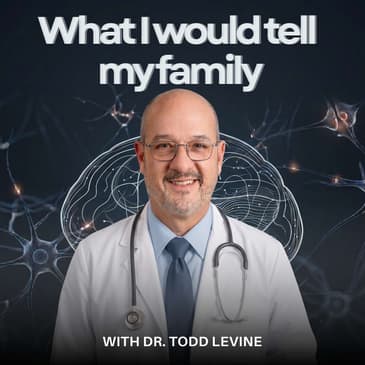
Welcome back to What I'd Tell My Family, the show where renowned neurologist Dr. Todd Levine answers your most pressing questions about brain and nerve health, the same way he would for his loved ones. In this special episode, Dr. Levine discusses his new book, Your Brain's Second Chance, co-authored with his wife Samantha, which challenges the idea that cognitive decline is inevitable. You'll hear how the latest advances in preventative neurology, lifestyle choices, and emerging biomarkers are reshaping our ability to protect and even optimize our brains as we age. Dr. Todd Levine shares insights from decades of experience, practical advice on sleep, diet, exercise, and stress management, and reveals why taking an active role in our brain health matters now more than ever. Whether you're concerned about family history or simply want to boost your cognitive health, this conversation offers hope and actionable steps for every listener.
Timestamps:
00:00 Preventative neurology and biomarkers
03:59 Father-in-law's health journey
08:44 Maintaining brain health as we age
11:39 Importance of REM sleep for brain health
15:30 Brain health and social interaction
18:04 Book offers tools for a healthy lifestyle
21:01 Wrapping up the episode
Preventative Neurology: Insights from "Your Brain’s Second Chance" with Dr. Todd Levine
Optimizing brain health and reducing the risks of Alzheimer’s and neurodegenerative diseases are hot topics in the medical world today. The recent episode of "What I Tell My Family with Dr. Todd Levine" offers a wealth of insights into how preventative neurology is shifting the focus from reacting to brain illness to actively working to prevent it. Below are some of the key takeaways from the conversation with Dr. Levine, a leading neurologist and author of the new book, "Your Brain’s Second Chance".
What is Preventative Neurology?
For decades, neurology primarily waited until a disease had already manifested before taking action. Dr. Levine highlights that traditional neurology had limited tools to reverse brain or spinal cord damage. The landscape has changed with advances in the field of biomarkers. Biomarker tests can now identify individuals at risk for conditions such as Alzheimer’s and Parkinson’s before the diseases take hold. This enables a proactive approach where the focus is on slowing disease progression rather than reacting after significant damage has been done.
The Role of Lifestyle in Brain Health
One of the central themes in Dr. Levine’s practice and his new book is the importance of lifestyle. He describes a holistic roadmap built on lifestyle, nutrition, sleep, exercise, and stress management. According to Dr. Levine, these pillars provide a real opportunity for individuals to take control of their brain health and potentially mitigate the risk of cognitive decline.
A standout point is the misconception that cognitive decline is inevitable or strictly determined by genetics. While genetics do play a role, environment and lifestyle are equally significant in determining brain health outcomes. Even individuals with genetic predispositions for diseases like Alzheimer’s can benefit from targeted lifestyle interventions.
The Importance of Sleep in Maintaining a Healthy Brain
One of the most powerful yet underestimated pillars for brain health is sleep. Recent research has shown that sleep is not just about rest but also about essential maintenance processes within the brain. During sleep, particularly REM sleep, the brain clears out harmful proteins such as amyloid and tau, which are associated with Alzheimer’s disease.
Dr. Levine stresses that effective sleep, where the body cycles through all stages including REM, is essential for brain health. People with sleep disorders like sleep apnea are at higher risk for neurodegenerative diseases because these conditions disrupt this natural cleaning process. Focusing on sleep hygiene and seeking treatment for sleep disruptions can have a profound impact on long-term brain function.
The Power of Mental Stimulation and Social Connection
Keeping the mind active is another important tool in combating cognitive decline. Dr. Levine explains that the brain can be thought of as a muscle; the more it is exercised, the more resilient it becomes. Higher education levels and consistent mental challenges appear to slow down the progression of Alzheimer’s symptoms. He also underscores the dangers of social isolation, particularly as people age or face memory loss, advocating for continued social interaction and mental engagement through activities, reading, or even learning new skills.
The New Frontier: Biomarkers in Early Detection
Perhaps one of the most game-changing advancements in neurology is the emergence of dementia risk biomarkers. These include blood tests that can indicate the presence of harmful proteins long before symptoms develop. While Dr. Levine suggests that everyone can benefit from adopting brain-healthy habits, those identified as "at risk" through biomarker testing should be especially proactive.
Biomarkers serve as an early warning, much like cholesterol tests do for heart health. Individuals with elevated amyloid levels can make informed decisions about lifestyle changes aimed at reducing their risk. While these tests are not a crystal ball, they provide a valuable opportunity to intervene well before irreversible damage has occurred.
The Takeaway: You’re Not Destined for Cognitive Decline
The central message Dr. Levine wants everyone to hear is this: cognitive decline is not inevitable. Each person has the ability to take an active role in protecting and optimizing brain health. Small changes made today, from prioritizing sleep to engaging the mind and building healthy social connections, can create a significant difference in quality of life as you age.
Dr. Levine’s book "Your Brain’s Second Chance" is designed to be a practical guide for anyone who wants actionable, science-backed advice for maintaining brain health at any stage of life. Start with one change, and over time, these small steps can lead to substantial improvements in neurological well-being.
Dr. Todd Levine on LinkedIn - https://www.linkedin.com/in/todd-levinemd/
Neuro Concierge - https://neuro-concierge.com/
Podcast - https://what-id-tell-my-family.beam.ly/
What I´d Tell My Family Podcast on LinkedIn - https://www.linkedin.com/company/what-id-tell-my-family/
Podcast Partner - https://www.tophealth.care/
Your Brain's Second Chance by Dr. Todd Levine - https://www.amazon.es/Your-Brains-Second-Chance-Levine/dp/B0H9TMH9N2
“Disclaimer: Informational only. Not medical advice. Consult your doctor for guidance.”