
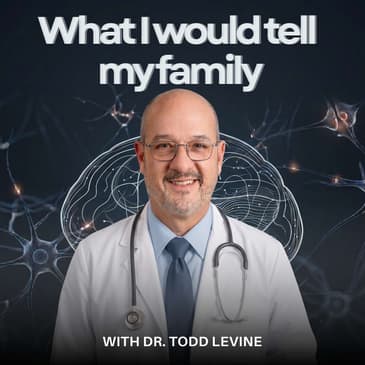
Welcome back to "What I'd Tell My Family." In today’s episode, we take a deep dive into one of the least discussed, yet most powerful predictors in neurology: the APOE4 gene and its connection to Alzheimer’s disease. Joined by Dr. Todd Levine, we unravel what it means to carry APOE4, the difference between having one or two copies, and how genetic information can shape the way we approach risk, prevention, and family conversations about memory loss.
We address the big questions: Who should get tested for APOE4? What does a positive or negative result actually mean? How can lifestyle changes and new advances in blood-based biomarkers impact your long-term brain health? And how should families navigate the complex emotions and decisions that come with learning about genetic risk?
Whether Alzheimer’s is part of your family story or you just want to better understand the role of genetics in dementia, this episode provides grounded advice, expert insight, and the candid conversation most clinics skip. Grab a seat at the table; this is information every family should hear.
Timestamps:
00:00 Understanding genes and proteins basics
05:00 Understanding the APOE Protein Function
08:57 Answering the "so what" question
12:02 Discussing Alzheimer's risk and prevention
14:16 Discussing Alzheimer's risk and treatments
20:17 Understanding genetic risk and biomarkers
21:53 Discussing genetic testing decisions
25:16 Discussing APOE and Alzheimer's treatment
27:30 Ending the conversation
Understanding APOE4 and Alzheimer’s Risk: Key Insights from the Podcast
Alzheimer’s disease is a topic that touches countless families, prompting questions about genetics, risks, and what one can do to protect their brain health. In the latest episode of the podcast, Dr. Todd Levine offers an in-depth look at the APOE4 gene, its role in Alzheimer’s risk, and what practical steps individuals and families should consider when facing these concerns.
What is APOE4 and Why Does it Matter?
Dr. Todd Levine explains that the APOE gene, specifically the APOE4 variant, plays a significant role in determining one’s risk of developing Alzheimer’s disease. ApoE stands for apolipoprotein E, a protein that helps clear toxins from the brain. There are three common types of APOE: type 2, type 3, and type 4. We inherit two copies of these genes, one from each parent. Depending on which variants you have, your risk of Alzheimer’s can change dramatically.
Having one copy of the APOE4 gene increases your risk for Alzheimer’s by about two to threefold, while two copies can boost your lifetime risk up to ten times that of the general population. Dr. Todd Levine highlights that about 50 to 60 percent of individuals with two copies of APOE4 may develop Alzheimer’s if they live long enough. Meanwhile, those with two copies of APOE2 may have a fairly low risk, around 5 to 10 percent.
Penetrance: Understanding Your Genetic Odds
Dr. Todd Levine introduces the concept of “penetrance,” which measures how likely it is for someone with a genetic mutation to actually develop the associated disease. Some genetic mutations, like amyloid precursor protein and presenilin, virtually guarantee early-onset Alzheimer’s if present, but these are rare. APOE4, on the other hand, is a risk factor rather than a guarantee, making it crucial for families with a history of Alzheimer’s to know their genetic status.
Should Everyone Get Tested for APOE4?
A common question faced by families is whether everyone should get tested for APOE4. According to Dr. Todd Levine, this decision rests on what the results will actually change for the individual. There are currently no medications specifically for APOE4 carriers, but lifestyle factors like a healthy diet, exercise, quality sleep, mental stimulation, and strong social connections have been proven to slow Alzheimer’s and other chronic diseases. If discovering a heightened risk would motivate a person to make these positive changes, testing can be worthwhile.
Interpreting Your Results: What If You Test Positive or Negative?
If you do not carry APOE4, your risk is about the same or lower than the general population, especially if you have APOE2. However, Dr. Todd Levine cautions that Alzheimer’s can develop without the APOE4 gene, as other genetic and environmental factors are involved. For those who test positive, particularly with two copies, the focus shifts to prevention and monitoring. Blood-based biomarkers, like PTAU and GFAP, can now detect disease activity years before symptoms appear, offering hope for early intervention as new therapies develop.
The Emotional Impact of Genetic Testing
Dr. Todd Levine recognizes the psychological burden that can come with learning your genetic risk. Some people want all the information they can get, while others prefer not to know unless symptoms develop. Both choices are valid, and genetic counseling can help families prepare for and understand the implications of test results.
Looking Forward: The Future of Alzheimer’s Prevention
Research into APOE4 is rapidly evolving, with pharmaceutical companies developing drugs aimed at clearing harmful proteins from the brain and enhancing the effectiveness of genetic clearance mechanisms. The hope is that early identification and targeted treatment will shift the paradigm from slowing Alzheimer’s to preventing it entirely.
Final Thoughts
Understanding your APOE4 status is a powerful tool, but the choice to get tested should be personal and well-informed. Dr. Todd Levine’s insights emphasize the importance of proactive health measures, clear communication with doctors, and individualized decision-making for each person and family. As research progresses, the information shared in this episode forms a vital foundation for future conversations about preventing Alzheimer’s and promoting lifelong brain health.
Dr. Todd Levine on LinkedIn - https://www.linkedin.com/in/todd-levinemd/
Neuro Concierge - https://neuro-concierge.com/
Podcast - https://what-id-tell-my-family.beam.ly/
What I´d Tell My Family Podcast on LinkedIn - https://www.linkedin.com/company/what-id-tell-my-family/
Podcast Partner - https://www.tophealth.care/
“Disclaimer: Informational only. Not medical advice. Consult your doctor for guidance.”